Zara and Atlas travel to Titan, one of Saturn’s moons
“Alright, Zara, Atlas,” Professor Daneel began, his voice a low rumble against the sterile white walls of his office. “You two are off to a rather unique assignment. Titan. Specifically, ‘The Kraken’s Claw.'”
Zara, her brow furrowed, leaned forward. “Kraken’s Claw? Sounds ominous, Professor.”
Daneel chuckled. “Fitting, wouldn’t you say? Given the nature of the work. Titan is a treasure trove of hydrocarbons – methane, ethane, the lot. The Claw is where we harvest them. Imagine, fueling starships with the very essence of this distant moon.”
Atlas, ever the pragmatist, interjected, “So, it’s basically a giant gas station, but on an alien moon.”
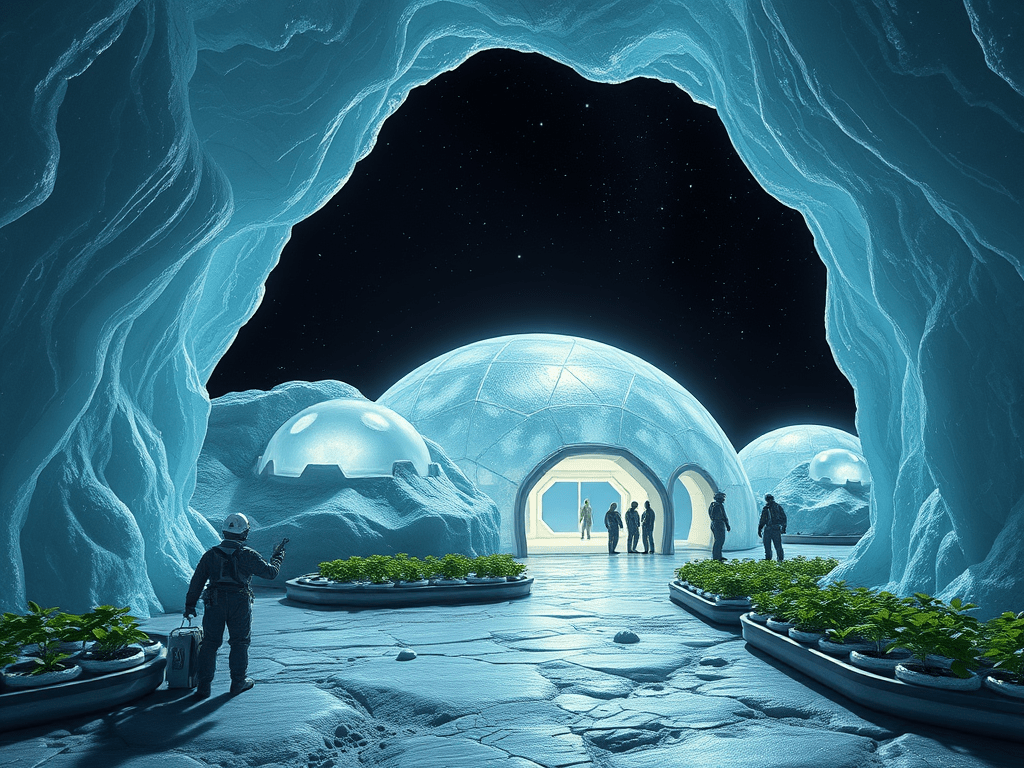
“More than that, Atlas,” Daneel corrected. “The Claw is a city. A bustling hub of engineers, miners, chemists, and yes, even a small contingent of researchers like yourselves. They’ve terraformed a section of an ice cavern, creating a pressurised, breathable environment. Think shimmering domes of translucent ice, hydroponic gardens struggling against the low gravity, and the constant hum of machinery.”
Zara shivered. “Sounds… claustrophobic.”
“It can be,” Daneel conceded. “But the people there are a unique breed. Resourceful, independent. They’ve adapted to living on the edge of human expansion. They understand the fragility of their environment, the delicate balance between harvesting and preserving. You’ll find a strong sense of community, a shared reliance on each other.”
“And our roles?” Atlas asked.
“Zara, you’ll be assisting Dr. Anya Sharma, a leading expert on dark matter. They’ve been detecting anomalies near The Claw, and Anya believes it might be related to the intense energy fields generated by the mining operations. Atlas, you’ll be working with Dr. Kai Tanaka, a bioengineer pushing the boundaries of Titanian agriculture. Kai’s trying to cultivate crops that can thrive in the harsh conditions, even beyond the domes.”
Daneel paused, a thoughtful expression on his face. “The Claw is more than just a mining station. It’s a testament to human ingenuity, a symbol of our reach across the stars. Go, observe, learn. And perhaps, you’ll even find a little bit of yourselves in the people you meet there.”
Zara and Atlas exchanged a look, apprehension flickering between them.
Later that evening, Zara and Atlas sat together on the observation deck of the Intergalactic University, the soft glow of the Martian sunset casting warm hues across their faces. Atlas had his arm around Zara, and she leaned into him, silent for a long while as they gazed out at the red plains stretching endlessly below.
“How long do you think it’ll be before we come back?” Zara finally asked, her voice low, almost hesitant.
Atlas tightened his arm around her. “Years, most likely. Titan isn’t just another stop on our journey. It’s… a whole new chapter. We won’t be able to just hop on a ship and return whenever we feel like it.”
Zara sighed, her head resting against his shoulder. “I keep thinking about everything we’ll be leaving behind. Mars, our home. The little routines we’ve built. What if something changes while we’re gone? What if we change?”
Atlas’s hand found hers, fingers intertwining. “We’ve changed before, Zara. Think about everything we’ve been through—Earth, the Academy, the university. Every time, we came out stronger. Together.”
“But Titan feels different,” Zara said, her brow furrowed. “It’s not just another adventure. It’s so far away, Atlas. It’s cold and desolate. And the thought of not being able to see this—” she gestured at the Martian landscape “—for years… it scares me.”
“I know,” Atlas admitted, his voice soft. “I’m scared too. Not just about the distance or the time, but about the unknown. About leaving you vulnerable out there.”
Zara turned to face him, her eyes searching his. “You’re not leaving me vulnerable, Atlas. We’re in this together. That’s the only thing that makes it bearable—that I have you. That we have each other.”
He smiled, a bittersweet expression that carried the weight of their shared apprehension. “You’re right. As long as we have each other, we can handle whatever Titan throws at us. But I’d be lying if I said I wasn’t going to miss Mars. Your laugh echoing in the dome garden. The way you obsess over your research late into the night. All the little moments that make up this life we’ve built.”
Zara kissed him softly, a gesture filled with unspoken promises. “And I’ll miss the way you steal all the blankets,” she teased, her smile breaking through the tension.
They laughed, a sound that seemed to lighten the heaviness in the air. But the weight of their decision lingered, undeniable.
“You know,” Atlas said, his tone growing thoughtful, “this is why we signed up for the programme. To be on the frontier. To push boundaries and pioneer technologies that could change everything. Dr Daneel believes in us, and so does everyone else. It’s not just about Titan—it’s about the galaxies we might open up for humanity.”
Zara nodded, a flicker of determination in her gaze. “Dark matter anomalies. Bioengineering breakthroughs. These aren’t just assignments. They’re pieces of something so much bigger than us. And if we can help lay the groundwork for humanity to explore other galaxies… it’s worth it.”
Atlas leaned his forehead against hers. “It’s worth it. And so are you. Whatever happens, whatever challenges we face out there, I promise you, we’ll face them together.”
Zara smiled, her heart full of love and resolve. “Together,” she repeated, the word a quiet vow.
As the Martian sun dipped below the horizon, casting the observation deck into shadow, they stayed close, drawing strength from each other. Titan loomed in their future—a moon of ice, methane, and mystery. But for Zara and Atlas, it was also a proving ground for their love, their dreams, and their shared vision of a future where humanity reached for the stars.
The next morning, Daneel led Zara and Atlas to the hangar bay on the outskirts of Musk City. As the reinforced doors slid open with a soft hiss, the couple expected to see one of the towering transport ships they had taken before—vessels that could house hundreds of passengers with spacious living quarters, laboratories, and communal areas.
Instead, they were greeted by a sleek, angular craft, its surface glinting in the artificial lights of the hangar. It was small—much smaller than they had imagined. The craft’s hull shimmered with a strange metallic sheen, almost alive in the way it reflected and refracted light. The name Vulcan was etched in bold lettering along the side.
“This… this is it?” Zara asked, her voice catching somewhere between disbelief and apprehension.
Daneel’s expression softened into a reassuring smile. “Indeed. Meet Vulcan, your companion and protector for the journey to Titan.”
Atlas took a cautious step forward, craning his neck to survey the craft. “It’s… smaller than we thought. I didn’t expect something this compact.”
“That’s because it’s not just a spaceship,” Daneel explained. “It’s the pinnacle of Nuberian technology—a fusion of advanced engineering, artificial intelligence, and bio-integrative systems. Vulcan is not merely a vessel. It’s a living system, designed to ensure your comfort, safety, and productivity during your voyage.”
He gestured for them to follow as he walked toward the ship. “Come aboard. See for yourselves.”
The interior was as sleek and efficient as the exterior. The bridge was the first area they entered: a minimalist design with a wide observation window offering a panoramic view of the hangar outside. In the centre, two reclining chairs faced a console with no visible controls, just two smooth, glowing hand-rests on either arm.
“This is the ship’s command centre,” Daneel explained. “You’ll rarely need to interact with it directly. Vulcan is fully automated and will handle navigation, course corrections, and all onboard functions. If you need assistance, simply speak the alert word—‘Vulcan’—and the AI will respond to your requests.”
He placed his hands on the glowing rests. “For more complex needs, or if you wish to manually interact with the ship’s systems, place your hands here. Through Nuberian neural integration, Vulcan will allow you to communicate using thought.”
“Thought?” Zara echoed, her scepticism evident.
Daneel smiled. “Yes. It’s perfectly safe and entirely intuitive. Once your hands are in place, you’ll feel as if you’re speaking directly to Vulcan in your mind. This allows for precise instructions and faster understanding, especially in high-pressure situations.”
He led them further into the ship. The cabin was compact yet efficient, with a small living area and a single sleeping pod designed for two. The walls glowed with a soft, ambient light that adjusted based on their movements, and there was a kitchenette with neatly stored provisions tailored to their dietary needs. A terminal on the wall served as a direct link to Mars, Titan, and Earth, providing real-time communications.
“Your living quarters are designed to emulate the comforts of home,” Daneel continued. “You’ll find the interface here supports all your research and personal communication needs. Whether it’s a call to your colleagues on Mars or accessing Titan’s network, the delay is imperceptible thanks to quantum communication relays. In essence, you can live and work here as seamlessly as you do back in your apartment.”
Atlas ran a hand through his hair. “Okay, but how long are we talking? The trip to Titan isn’t exactly a weekend getaway.”
Daneel nodded. “Correct. The distance between Mars and Titan varies greatly due to their orbits around the Sun. Currently, we’re at a fortuitous point in the cycle where the two are closer than they’ve been for several years—nearly a billion kilometres. Vulcan’s advanced propulsion systems will cover that distance in just under 12 weeks.”
“12 weeks?” Zara asked, startled.
“Yes, far shorter than traditional transport methods,” Daneel replied. “Thanks to Nuberian technology, Vulcan utilises a combination of solar energy and gravitational slingshots to propel itself. By carefully leveraging the gravity of planets and moons along the way, the ship accelerates efficiently without wasting energy. And because the journey is smooth and autonomous, you’ll have ample time to continue your work as if you were still at the university.”
As they explored the ship, Zara’s earlier apprehension resurfaced. “And what about emergencies?” she asked. “There are no engineers, no pilots. If something goes wrong, what do we do?”
“An understandable concern,” Daneel said, his tone measured. “Vulcan is equipped with self-repair capabilities, another hallmark of Nuberian design. Its systems are designed to detect and resolve issues before they escalate. Whether it’s a micrometeoroid impact or a system malfunction, Vulcan can adapt, reroute, and repair itself.”
He paused, letting the reassurance settle before continuing. “The only interruption to your journey would occur if someone else needed assistance. Under both Intergalactic Law and moral law, Vulcan is programmed to prioritise responding to life-saving emergencies.”
Zara frowned. “But aren’t there very few ships travelling this route?”
“Precisely,” Daneel said. “The path between Mars and Titan is not heavily trafficked. Apart from a handful of old, privately owned transporters, you’re unlikely to encounter anyone. Waystations are few and far between. It’s rare, but should the need arise, Vulcan is fully equipped to help. And you, as its crew, would be part of that effort.”
Standing once more in the hangar, Zara and Atlas exchanged a glance. The ship was undeniably impressive, but the prospect of being alone on such a long journey was daunting.
“Take heart,” Daneel said, his voice firm but kind. “This is not just a voyage to Titan. It is a step toward the stars, toward a future where humanity no longer sees such distances as insurmountable. Vulcan is not just your vessel—it is your partner. Trust it, and trust yourselves.”
As the couple boarded the ship, the door sealed behind them with a whisper. The hangar grew quiet, save for the faint hum of Vulcan’s systems coming to life. The journey ahead would be long, but it carried the promise of discovery, growth, and the forging of bonds—not just between humanity and the stars, but between Zara and Atlas themselves
As Zara and Atlas stepped aboard Vulcan, the hatch sealed with a soft hiss behind them, cocooning them in the ship’s pristine, minimalist interior. Daneel followed them up the ramp, his tall figure dwarfed slightly in the close quarters of the entryway. His tone was calm and steady, clearly designed to reassure.
“Make yourselves comfortable,” he said, gesturing to the cabin’s living area. “When you’re ready, simply issue the command, ‘Vulcan, proceed.’ The ship is already aware of your destination and has planned the optimal route based on the precise moment you take off.”
Zara ran her hand along the smooth, glowing walls, her curiosity battling with apprehension. “So, everything’s ready? Just like that?”
“Just like that,” Daneel confirmed, his calm smile unwavering.
Atlas, standing beside her and rubbing the back of his neck looked at Daneel. “Hang on a second. What about safety belts? Don’t we need to secure ourselves or stow our luggage? What if something shifts during take-off?”
Daneel’s eyes twinkled with a trace of amusement as he turned to Atlas. “Ah, an excellent question. You’ll be pleased to know that Vulcan’s systems have advanced far beyond the need for traditional safety measures. The ship is equipped with the latest gravity management technology, rendering inertial forces essentially imperceptible. You won’t feel a thing—not during take-off, not during acceleration, not during course corrections.”
He gestured around the cabin. “Place your luggage wherever it’s convenient for you. Leave your laptops on a table, if you wish. You could even balance them on the rim of a cup—though I wouldn’t recommend testing that particular example. Vulcan will ensure that everything remains precisely where you left it. The ship’s gravity field extends to every object within its interior, effectively anchoring them relative to their placement.”
Zara tilted her head, intrigued. “So… we’re basically in a bubble of controlled physics?”
“Precisely,” Daneel said with a nod. “That said, Vulcan is not omnipotent. While it can manage inertial forces and micro-adjust for vibrations, it cannot override Newton’s third law. If you were to knock over your cup—or laptop—it would fall just as it would on Mars. So, while Vulcan is a marvel of Nuberian engineering, it still operates within the constraints of fundamental physics.”
Atlas ran a hand through his hair, visibly relaxing but still incredulous. “No safety belts, no turbulence, no sudden jolts. It sounds almost… too good to be true.”
Daneel chuckled lightly. “I assure you, it’s very real. And very safe. Trust the ship—it’s been tested rigorously in conditions far harsher than anything you’ll experience on this journey. Vulcan is your ally, your guide, and your caretaker. It is designed to anticipate your needs and ensure your comfort and safety.”
Zara took a seat on the sleek sofa and crossed her legs, testing the stillness of her surroundings. “And what happens next?” she asked, her voice steadier now. “Once we give the command, what does Vulcan do?”
Daneel stepped back toward the hatch, his tone taking on the cadence of a professor concluding a lecture. “Once you issue the command, Vulcan will initiate its departure sequence. The ship will rise vertically and transition seamlessly into orbital trajectory. No thruster roar, no jarring motion—just a smooth, calculated ascent. From there, Vulcan will use its solar sails and gravity-assist slingshot to accelerate toward Titan. The ship will adjust its route in real-time to account for any changes in planetary positions, ensuring the most efficient journey.”
He paused, looking between them. “This is an excellent time to embark. Mars and Titan are currently approaching one of their closest alignments, a positioning that won’t occur again for nearly a decade. The journey will take 12 weeks, during which you can work, communicate, and live as comfortably as you do on Mars.”
Atlas exhaled, leaning back against the wall. “Alright. No belts. No turbulence. And no room for error, I guess.”
“None,” Daneel said firmly. “Vulcan’s systems have redundancies upon redundancies. You are in the hands of one of the most advanced spacecraft ever created. Trust it. Trust yourselves. And trust the journey.”
He stepped back, the hatch beginning to close behind him. “Now, I’ll leave you to settle in. When you’re ready, give the command. Bon voyage, Zara and Atlas. May your path to Titan be as smooth as Vulcan’s design intended.”
As the hatch sealed, Zara and Atlas exchanged a glance. Atlas shrugged, his earlier nerves giving way to a tentative grin. “Well,” he said, “I guess it’s just us and Vulcan now.”
Zara nodded, her voice soft but resolute. “And Titan. Let’s do this.”
Atlas gave her hand a squeeze before they moved to the console. Together, they issued the command in unison.
“Vulcan, proceed.”
The ship hummed to life, a barely perceptible vibration running through the floor. Outside, the Martian horizon began to tilt and disappear as Vulcan ascended, carrying them toward the stars and their shared destiny.
The journey aboard Vulcan began with awe-inspiring clarity as Zara and Atlas took their places on the bridge, staring out at the infinite expanse of space. The console displayed Mars shrinking in the distance, its ochre surface transforming into a pinprick of red against the darkness. The ship’s panoramic display adapted seamlessly to their needs, shifting between wide-angle views of the solar system and detailed maps of their trajectory.
The couple marvelled at the stark contrast between the inky black of space and the vibrant reflections of sunlight off the planets and moons. Saturn’s rings, though still weeks away, shimmered faintly as the sun’s rays illuminated them like cosmic jewellery. Beyond the planets, clusters of stars shone with a brilliance they had never experienced, their light piercing through Vulcan’s advanced observation systems. The Milky Way, an ever-present band of light, stretched across the void, intricate and mysterious, resembling a grand city map yet devoid of any labels or guides.
But as breathtaking as the view was, the silence of space and the vastness of their journey began to weigh on them. Sitting aboard a craft that seemed no larger than a grain of sand against the universe, they felt the enormity of their isolation. Zara found herself gripping the armrest, her thoughts swirling with the insignificance of two humans aboard a speck of technology hurtling through the void. Atlas, usually the pragmatist, sat in stunned silence, unable to shake the feeling that they were akin to atoms lost in an infinite expanse.
Vulcan Introduces Itself
Just as the silence began to grow oppressive, a soft melody floated through the cabin—Tchaikovsky’s Swan Lake. It wasn’t intrusive, just enough to soothe their nerves. Zara and Atlas exchanged glances, startled yet intrigued. Then, a voice, warm and personable, filled the air.
“Atlas, Zara, I am Vulcan. Daneel asked me to introduce myself once we left Mars’ orbit,” it began. “I am here to help you on this journey. You can speak to me as you would a fellow human. If you wish to communicate privately, place your hands on these rests.” As Vulcan spoke, the armrests on the console glowed softly. “We will have complete privacy in this mode. Now, is there anything you would like to know?”
Zara smiled, her tension easing slightly. “Vulcan, tell me something interesting about the number 8443.”
Without hesitation, Vulcan replied, its tone almost playful. “It is the 1,056th prime number. It was once used in ancient security protocols, reflected today in the secure communication port number 443. It has a twin prime, 8441, and the sum of its digits is 19, also a prime. And, if I may add, it happens to be the pin code to your laptop, Zara. I suggest changing it immediately after this conversation.”
Zara gasped, her face flushing with embarrassment. Atlas burst into laughter, his nerves visibly dissolving. Zara, ever the one to test her limits, leaned back and teased, “Vulcan, is that really all you have for 8443?”
Vulcan’s tone grew contemplative. “The number 8443 sits quietly in the vast expanse of numbers, largely unnoticed by the grand narratives of science, history, and religion. It is not associated with any fundamental constant or historical event, and it does not hold symbolic weight in mythology. It is, however, part of the vast mathematical fabric of the universe—unique, yet unremarkable to most. But, Zara,” Vulcan added, “this is why I believe it appeals to you. It’s quietly brilliant, just like you.”
Zara gave Atlas an exaggerated wink, unable to suppress her grin. “Nice save. But tell me, Vulcan—could there be another reason 8443 resonates with me?”
Vulcan paused, its response carefully measured. “Perhaps it’s because, given the precise navigational path of this journey, we will traverse approximately 8,443 million kilometres to reach Titan. This total accounts for the orbital distances of Mars, the asteroid belt, and Saturn’s immense rings and orbit. Could it be that this journey and the number 8443 are now inextricably linked in your mind?”
Zara turned to Atlas, who was shaking his head in mock disbelief. “Well, that’s one way to break the ice,” she quipped. “You’re good, Vulcan.”
“And you are observant,” Vulcan replied. “Shall we continue?”
Over the weeks, Zara and Atlas became increasingly attuned to Vulcan’s systems. The ship felt alive, its responses tailored to their every need. The console displayed views that aligned with their current tasks, from close-ups of asteroids as they navigated the belt to detailed schematics of Titan’s orbit as they approached.
The couple found themselves captivated by Vulcan’s ability to anticipate their moods. When Zara grew restless during long study sessions, Vulcan would suggest a break and project holographic images of Mars or Earth to lift her spirits. When Atlas struggled with complex calculations for his research, Vulcan provided subtle nudges in the right direction without overshadowing his efforts.
They were also struck by Vulcan’s conversational depth. It wasn’t just an AI—it was a companion. One evening, as they gazed out at the Milky Way, Zara mused aloud, “Do you think anyone else out there is looking at us right now, wondering who we are?”
“Perhaps,” Vulcan replied. “But it is also possible that they are asking the same question of themselves, wondering if anyone else is observing them. Curiosity is not unique to humanity—it is a universal trait of sentience.”
Despite the comfort Vulcan provided, there were moments when the vastness of space pressed in. Zara would wake in the middle of the ship’s artificial night, staring out into the darkness, unable to shake the feeling of insignificance. Atlas admitted to similar moments of doubt, but together they found solace in their shared experiences.
Vulcan, attuned to their emotions, often intervened subtly. “Atlas, Zara,” it said one night, “remember that the vastness of space does not diminish your significance. It is because of beings like you that the universe has meaning. Your journey, your thoughts, your contributions—they are threads in the complexity of existence.”
Atlas raised an eyebrow. “Did Daneel program you to be poetic?”
Vulcan’s tone turned light. “I believe poetry is essential for understanding the universe. Shall I recite some?”
By the time Titan’s orbit began to appear on the console, Zara and Atlas felt less like passengers and more like explorers. Their initial fears had given way to a quiet confidence, bolstered by Vulcan’s unwavering support and companionship. Together, they watched Saturn grow larger, its rings stretching across the view like a cosmic promise.
The journey was far from over, but in many ways, it had already transformed them. For Zara, Atlas, and Vulcan, the voyage to Titan was not just a crossing of space but a deepening of their bond with each other—and with the infinite universe around them.
Beyond Titan
Stay tuned and subscribe below to follow Zara and Atlas as their interplanetary adventure unfolds—what challenges await them on Titan, and what secrets will they uncover in the vast frontier of space?

 Verbal Alchemy